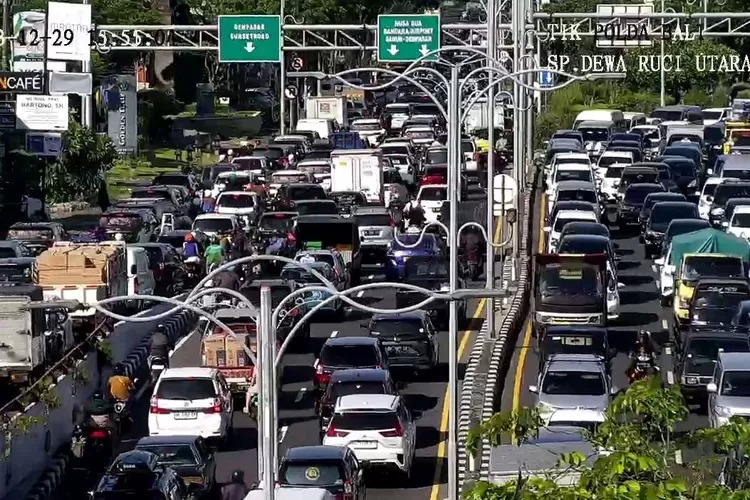
As reported by Kompas, the commitment and capability of Bali’s Provincial Administration to resolve the severe traffic congestion plaguing the island are once again being called into question, as the number of private vehicles in Bali now exceeds the island’s population.
Amid a surge in private vehicle numbers that now surpass Bali’s population, the lack of public funding for public transportation is considered far from ideal. Data from the Bali Central Statistics Agency (BPS) indicates that the number of registered vehicles on the Island of Bali reached 5.2 million units in 2025. This figure far exceeds Bali’s total population of approximately 4.4 million people.
I Ketut Sugihantara, M.SA., Secretary of the Shri Kesari Warmadewa Foundation, noted that this disparity is highlighted by a vehicle growth rate of 5 percent per year—far outpacing the population growth rate, which averages only 1 percent annually.
”This situation contributes directly to traffic congestion in Bali,” Ketut explained during a public forum titled “Bali Discusses the Future of Public Transportation” held at Warmadewa University, Denpasar, on Thursday, 27 August 2026.
Minimal Funding and Transportation Subsidy Allocation
Despite the increasingly urgent degree of traffic congestion and the mobility needs of Island residents, the share of the regional budget allocated to public transportation remains extremely limited. Haiqal Rizaldi, Lead for the Bali Transport Decarbonization Project at WRI Indonesia, has criticized the Bali Provincial Government’s low level of fiscal commitment to public transport subsidies. Of the total 2026 Bali Provincial Budget (APBD) of Rp 6.3 trillion, the confirmed allocation for public transport subsidies is only 0.9 percent.
”If we compare Bali to Semarang City—which has a regional budget (APBD) scale similar to Bali’s, at around IDR 5.5 trillion—Semarang allocates 4.7 percent of its budget to public transport and manages to serve 60.7 percent of its population. Unfortunately, Bali has only allocated 0.9 percent of its 2026 budget to public transport,” explained Haiqal.
Urban public transport coverage in the Denpasar, Badung, Gianyar, and Tabanan (Sarbagita) areas of Bali currently covers only about 10 percent of the total territory. What’s more, reliance on private vehicles contributes approximately 43 percent of total greenhouse gas emissions in Bali Province.
The Tangible Impact of Service Cuts
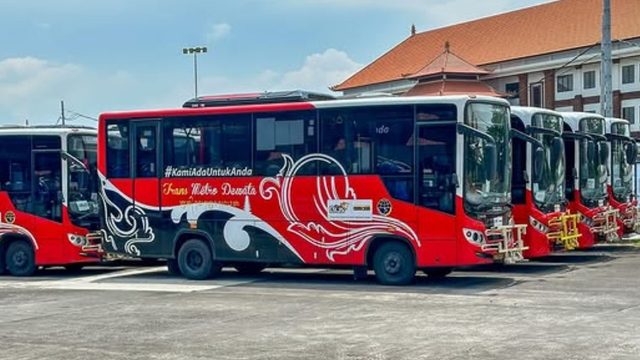
The vulnerability of Bali’s public transport budget was made evident when Trans Metro Dewata (TMD) Bus Operations were halted in 2025 due to budgetary restraints. Dyah Roosline, Coordinator of the Bali Transport Discussion Forum (FDTBali), revealed that the service suspension directly and immediately impacted vulnerable groups, ranging from students and low-income residents to people with disabilities.
This impact and vulnerability were affirmed by Made Suardana, a visually impaired individual who uses the TMD Services for his daily activities and to earn a living while traveling between Tabanan and Denpasar. “The TMD bus is a huge help to our businesses and livelihoods. We hope the service won’t be stopped again like it was before, and ideally, it should even be expanded,” said Made.
Since April 2025, TMD operations have utilized a Special Financial Assistance (BKK) Scheme involving the Bali Provincial Government and the regencies/city governments within the Sarbagita area. However, this scheme has faced obstacles due to adjustments to budget transfers from the central government and, most notably, Denpasar City, which is still evaluating its local contribution to the provincial service subsidy.
Evaluation Results Should Not Be Sole Grounds for Cutting Subsidies.
Responding to scrutiny of the transport support scheme, the Head of the Bali Provincial Transportation Agency, I Kadek Mudarta, explained that the BKK (Special Financial Assistance) Scheme was designed to ensure that the financing burden is shared among local governments within the Sarbagita region. Currently, the TMD Service records an average of 5,000 passengers per day. “Service evaluation is certainly essential for improvement, but it should not serve as a sole reason to reduce subsidies,” Mudarta emphasized.
The Bali Provincial Government is also currently working to establish a Regionally-Owned Enterprise (BUMD) for transportation to optimize governance and expand service corridors.
Meanwhile, a member of Commission V of the House of Representatives (DPR RI), Irine Yusiana Roba Putri, asserted that public transportation must not be sidelined in regional development priorities. “I disagree with the notion that public transportation is not a basic (essential) service and therefore not a priority. It plays a major role in meeting daily mobility needs. While the reduction in central government transfers does have an impact, Bali can leverage its unique characteristics (as a tourism destination) and its contribution to foreign exchange earnings to garner (additional) support from the central government,” said Irine.
Related Links
Will Bali’s Urban Bus Service Survive?
S. Korea to Create Electric Busses for Bali
When in Bali, Take the Public Bus!
Electric Bus System Launched in Bali
Stay Informed on Bali Tourism-Related News: Subscribe to Bali Update