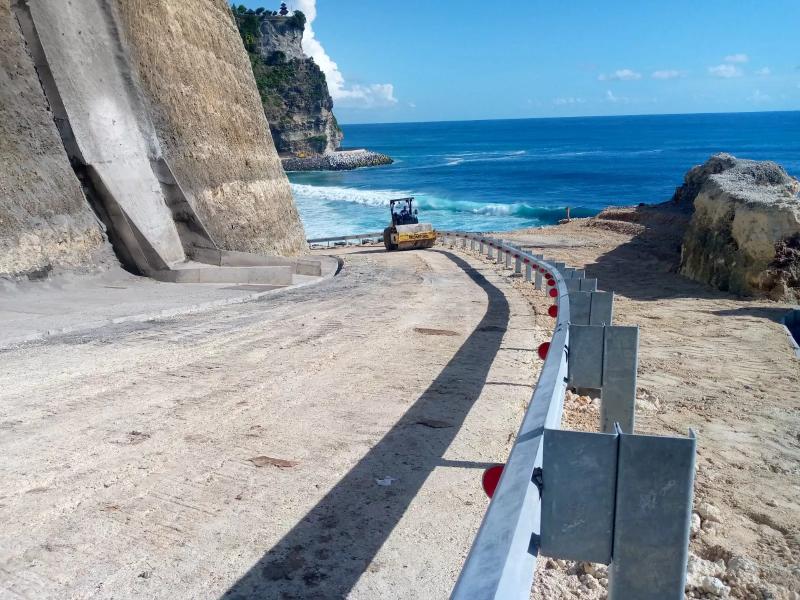
NusaBali reports that the Badung Regency Government in Bali is confirming that construction of a seawall and reinforcement of the supporting cliff face beneath Bali’s iconic 11th-century Uluwatu Temple are continuing. The Regent of Badung, I Wayan Adi Arnawa, confirmed the ongoing project during Pujuwala prayer ceremonies recently held at the Uluwatu Temple.
Arnawa alluded to the many benefits provided by the seawall, which prevents destructive abrasion and corrosion from waves crashing against it, and to the access it provides for public use during religious ceremonies.
“We will continue work on this seawall because it greatly facilitates access for ceremonial activities, as well as preventing abrasion and addressing corrosion. The results also provide beautiful views. Therefore, we will continue this program,” said Arnawa.
The regent, who hails from nearby Pecatu Village in South Kuta, emphasized that the redevelopment of the sacred cliffside area is not limited to the Pura Luhur Uluwatu Temple. The local government is also preparing to reorganize the Pura Luhur Pucak Mangu Temple area in Petang District.
“Not only here, but the Pura Luhur Pucak Mangu area will also be reorganized. It is currently under review, including the arrangement of the parking area and other supporting facilities,” he said.
Through these programs, the Badung Regency hopes to protect sacred areas from environmental damage. Moreover, the public is expected to feel safer and more comfortable when performing religious activities.
Meanwhile, Pecatu Traditional Village Head, Made Sumerta said that seawall construction will continue in the Pura Batu Metandal area. He said that continued evaluation is still needed because the Uluwatu coastal area experiences sustained strong ocean currents. Therefore, the effectiveness of the construction remains to be tested by time.
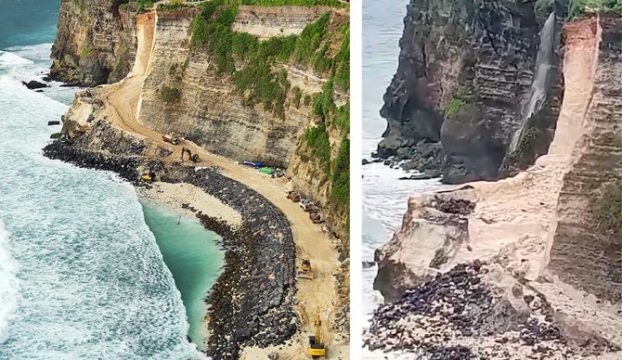
Sumerta explained that current development efforts are prioritizing measures that strengthen the cliffs to prevent erosion from waves, which could trigger further abrasion and landslides. Once the area’s protection is in hand and successful, construction in other areas will be undertaken.
Sumerta took pains to clarify the function of the path built adjacent to the seawall. He explained that the path is not a public road but an inspection road used to access traditional and religious activities.
“This path is not a public road, but rather an inspection road that also supports access to religious activities. In principle, the community shares the same commitment to maintaining this function,” he emphasized.
Related Link
Repairing Bali’s Cracked Batu Bolong Temple
Fears Grow Over a Balinese “Cliffhanger”
Uluwatu Temple Cliff Set to Crumble?
Plans to Strengthen Uluwatu Temple Delayed
Stay Informed on Bali Tourism-Related News: Subscribe to Bali Update