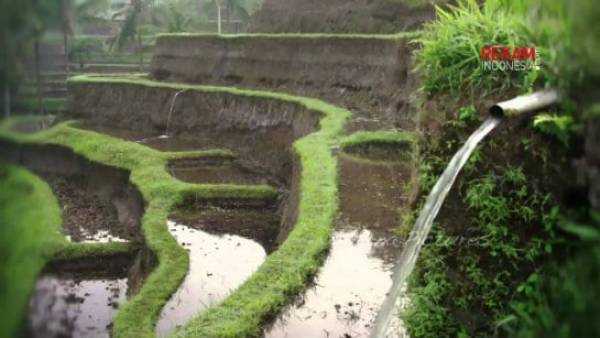
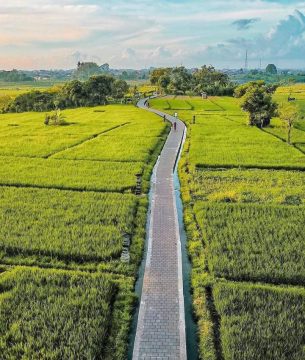
Detik.Travel and BeritaBali are warning that the centuries-old traditional irrigation system in Bali, known as “Subak” is under threat of extinction. The time-honored complex water distribution system is facing marginalization to the point of insignificance because of villa and hotel development that wantonly usurps land once used for traditional agriculture.
An Academic Perspective
According to BeritaBali, Professor Dr. Drs. I Nyoman Sunarta, M.Si., a leading tourism and environment scholar at Bali’s Udayana University, asserts that the Subak system is critical for safeguarding Bali’s agricultural heritage amid rapid development.
“This is one of our cultural institutions, the subak. Subak irrigation. That’s what we should preserve,” he recently explained.
Sunarta says maintaining and strengthening Subak helps better control development that harms agricultural land and irrigation.
“At the very least, these developments can be curbed, especially those that damage irrigation and our rice fields in Bali. That must be curbed,” he stated.
He says the government and stakeholders must enforce stricter spatial planning and more detailed zoning to determine which areas to develop or protect.
“There are many other areas. Zones should be established to permit and prohibit development. We need to know where we should reduce activities and where we should facilitate them,” he explained.
Sunarta acknowledges that tourism-driven development is unavoidable in Bali but stresses that the tourism sector must prioritize quality growth to preserve Subak and the agricultural landscape.
He explained that the government and stakeholders need to implement more stringent spatial planning through development zone mapping. This step is crucial for determining which areas can be developed and which must be protected from development pressures.
“There are many other areas. Zones should be established for permitting and prohibiting development. We need to know where we should reduce activities and where we should facilitate them,” he explained.
Sunarta believes that Bali cannot completely avoid the development of the tourism sector, which has driven the construction of various accommodation facilities. However, tourism development must be more focused on quality rather than quantity.
He argues that true tourism success should enhance local community well-being, as they are the core stewards of Bali’s distinct cultural and natural allure, not just increase visitor counts or economic turnover.
The three main elements of the Subak system are:
- parahyangan (subak temple)
- pawongan (subak members such as the Pekaseh or Head of a Subak)
- palemahan (subak land).
An Academic Perspective
A distinguished professor of tourism and the environment from Bali’s Udayana University, Professor Dr. Drs. I Nyoman Sunarta, M.Si., claims that Bali’s subak system plays a strategically important role in preserving agricultural lands and practices amidst the Island’s rapid pace of development.
“This is one of our cultural institutions, the subak. Subak irrigation. That’s what we should preserve,” he recently explained.
Sunarta believes that if the subak system is properly maintained and strengthened, development that could potentially damage productive agricultural land and irrigation networks can be better controlled.
“At the very least, these developments can be curbed, especially those that damage irrigation and our rice fields in Bali. That must be curbed,” he stated.
He explained that the government and stakeholders need to implement more stringent spatial planning through development zone mapping. This step is crucial for determining which areas can be developed and which must be protected from development pressures.
“There are many other areas. Zones should be established for permitting and prohibiting development. We need to know where we should reduce activities and where we should facilitate them,” he explained.
Sunarta believes that Bali cannot completely avoid the development of the tourism sector, which has driven the construction of various accommodation facilities. However, tourism development must be more focused on quality than quantity.
He explained that the government and stakeholders need to implement more stringent spatial planning through development zone mapping. This step is crucial for determining which areas can be developed and which must be protected from development pressures.
“There are many other areas. Zones should be established for permitting and prohibiting development. We need to know where we should reduce activities and where we should facilitate them,” he explained.
Sunarta believes that Bali cannot completely avoid the development of the tourism sector, which has driven the construction of various accommodation facilities. However, tourism development must be more focused on quality than quantity.
According to him, tourism success is not only measured by the number of tourist visits or the magnitude of economic turnover, but also by the ability to improve the quality of life of local communities, who are the primary guardians of the Island of the Gods’ appeal.
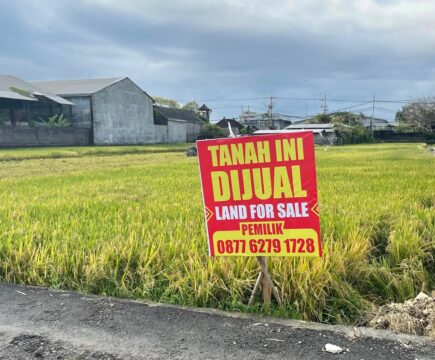
Subak Lands in Denpasar’s Metropolitan Setting
Raka Purwantara, Head of Denpasar’s Culture Service (Disbud), emphasizes the mounting challenges facing Subak in urban areas: aggressive land conversion and pressure to turn Subak zones into ecotourism sites.
The Problem of Effective Monitoring by Traditional Villages
Purwantara stated that the establishment of awig-awig or perarem (customary rules) has generally been handled by traditional villages. However, in practice, subak regulations only bind traditional village residents who own the local land.
”So, when the land was sold, I used to be in the Intaran Traditional Village, as the land owner, I was bound by awig-awig. But when it was sold and owned by someone else who was not from the Intaran Traditional Village, it became difficult to impose any customary sanctions,” he said.
Denpasar’s subak system now has only 1,915 remaining hectares. Purwantara said this condition creates difficulties for traditional villages in monitoring their traditional community, Subak. He admitted that the land had been certified and was, as a result, outside the traditional village’s authority.
”If private land is certified, it will be difficult for us to intervene. Because the transaction or signing of the certificate does not go through the Pekaseh (Subak Chief). The legal enforcement is limited according to what is in the certificate,” said Purwantara.
This is also supported by the existence of Regional Regulations (Perda) on Regional Spatial Planning (RTRW), developed through collaboration among regional officials.
”If the designated land use is changed, it may already be bound by the RTRW Regional Regulation. If it is awig-awig, it might not be able to bind things governed by the RTRW Regional Regulation,” added Purwantara.
Changing Planting Patterns, Adapting Land Use
The Denpasar Cultural Agency notes smaller land lots and polluted irrigation, and advises urban farmers to adapt their planting patterns.
”Even though land parcels are getting smaller, we shouldn’t lose the local culture of farming. If it’s an urban area, horticulture is more suitable. If it’s only 15 ares (1,500 square meters), planting rice might not be profitable. But if we divide the 15 ares by planting flowers, corn, eggplant, tomatoes, and other annual crops, that can be adopted,” said Purwantara.
Purwantara also said that this planting pattern was actually brought by immigrant farmers coming from outside Bali. Meanwhile, local farmers remain focused on rice cultivation.
”Our Balinese farmers haven’t seen the opportunity. That opportunity is seen by urbanites who come to Denpasar. Javanese people come here, rent our land, and live there, for example, renting 10 ares for a few years. They’re smart. Planting melons and chilies is their strategy,” said Purwantara.
He urges farmers to adjust their mindset, explore new planting patterns and markets, and adopt new technology.
”Our farmers aren’t good at anticipating market demand. When there’s a series of holidays, like Ramadan, chili and tomato prices go up. That’s how our farmers can have their rice fields bearing fruit during Ramadan.”
He says upstream areas, such as East Denpasar, with cleaner water, suit rice, while downstream areas, such as Sidakarya and Intaran, suit horticulture.
Related Links
Subak Agriculture on Wikipedia
Bali Rice Fields No Longer Available for Villa Construction?
Bali to Ban Building More Hotels, Villas, & Restaurants
Governor Koster: No Moratorium on Hotels & Villas
Escalating Overtourism in Bali
Moratorium on Development: 2 or 10 Years?
Equitable Approach to Tourism Development
Support Grows for 2-Year Bali Moratorium
Time for Moratorium on S. Bali Development?
BTB-GIPI Supports Bali Hotel Moratorium
Megawati Wants Bali Hotel Moratorium
Bali to Limit Number of Foreign Tourists?
Stay Informed on Bali Tourism-Related News: Subscribe to Bali Update