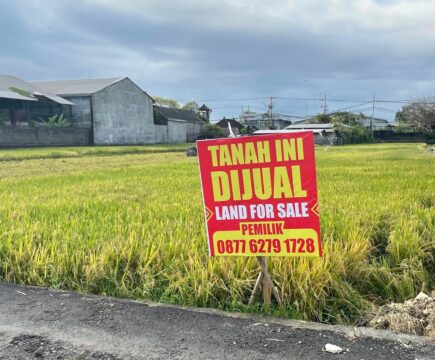
NusaBali reports that the current surge in investment and tourism development is placing increasing pressure on Bali’s agricultural land. Rising land values confront farmers with a difficult choice: retain their rice fields or sell them for a price equivalent to multiple years of crop yields.
Bali Governor Wayan Koster recently stated that when investors offer land prices equivalent to 10–20 years of harvest yields, the decision to sell becomes a very difficult and confronting choice for farming families.
“When investors offer land prices equivalent to 10–20 years of harvests, selling the land becomes a very understandable choice for farming families,” said Koster in a keynote address at a seminar titled ‘Synergy Between Local Government, the Ministry of ATR/BPN, Notaries, and Land Deed Officials (PPAT) to Protect Bali’s Agricultural Land Amidst Investment Flows and Maintain Sustainable Development in Bali’, held at the Hongkong Garden Restaurant, East Denpasar, on Sunday. 20 September 2026.
According to Koster, a mere ban on land-use conversion is proving insufficient to preserve rice fields. Protection policies must be paired with tangible incentives to keep farming economically attractive.
“A ban on land-use conversion alone is not enough. Agricultural land protection must be accompanied by tangible incentives for farmers, making the retention of rice fields a viable economic choice,” he said.
Pressure on agricultural land is further compounded by farmer succession. People over the age of 50 currently dominate Bali’s agricultural workforce, while interest among the younger generation in pursuing agricultural pursuits is increasingly limited.
This situation has become a serious challenge. Agricultural land preserved today risks going uncultivated in the future if no next generation continues its cultivation.
“Agricultural land preserved today risks going uncultivated in the future if there is no generational farmer succession,” Koster said.

Therefore, land protection must go hand in hand with improving the welfare and sustainability of the farming profession. Such efforts are necessary to safeguard Bali’s food sovereignty amidst the expansion of investment and tourism.
Bali already has a provincial regulation—Bali Provincial Regulation Number 4 of 2026—that limits productive land conversion and prohibits nominee-based land ownership. Koster has called for strengthening this regulation by involving Notaries and Land Deed Officials (PPAT).
According to Koster, Notaries and PPATs play a crucial role not only in validating transactions but also in preventing nominee practices in land ownership.
“Notaries and PPATs are at the forefront of preventing nominee practices, as such practices can involve various forms of land deeds and agreements,” he stated.
Koster also emphasized that Bali’s development must not merely pursue short-term economic value. Investment and tourism growth must also consider agricultural sustainability, environmental preservation, and community welfare.
“We must not sacrifice Bali for the sake of money,” Koster asserted.
In Governor Koster’s view, protecting agricultural land is integral to Bali’s future development, prioritizing a balance among nature, culture, and the well-being of the Balinese people as key components of sustainable development.
What Could Be Done to Conserve and Preserve Agricultural Lands in Bali?
Among the unexplored steps that could stop or, at least, slow the ongoing rapid disappearance of agricultural lands being converted for use by hotels, villas, and commercial use include:
- Tax-free status for agricultural land: The Provincial Administration of Bali could exempt all land in Bali declared as “Sustainable Food Agricultural Land” (Lahan Pertanian Pangan Berkelanjutan -LP2B) from paying land taxes (Pajak Bumi), provided it remains as actively cultivated land.
- High Capital Gains Taxes when land is Sold for Non-Agricultural Pursuits. When agricultural land is sold to a new purchaser who intends to convert its future use to non-agricultural purposes, such as building a private villa, hotel, or commercial business, punitive formulas for calculating capital gains tax could be applied to the purchase price. To address the possibility of under-reporting actual sale prices to avoid high capital gains tax liability, tax calculations could be based on independent assessments by third-party assessors engaged by the Province.
- Centralize the Power of ‘Final Approval’ to a Single Agency – PLN. The illegal and non-procedural usurpation of LP2B lands for non-agricultural pursuits is currently accomplished by either ignoring the established building permit (IMB) process or “shopping” the permit process by obtaining only one or two permits that can be shown when covering development activities while building otherwise non-conforming (i.e., illegal) structures. This has created an axiomatic belief that, when building illegally in Bali, do so quickly, as officials are typically reluctant to order the demolition of established villas and hotels, regardless of such buildings’ glaring infringement of zoning and LP2B limitations. How to overcome this difficult conundrum? The most straightforward solution would involve multi-agency inspectors empowered to terminate or refuse PLN (i.e., electricity) connections to any structure that does not conform to zoning and spatial rules or that stands on LP2B lands. Luxury villas and hotels become immediately non-viable when they are refused electrical connection.
The most straightforward solution would involve multi-agency inspectors empowered to terminate or refuse PLN (i.e., electricity) connections to any structure that does not conform to zoning and spatial rules or that stands on LP2B lands. Luxury villas and hotels become immediately non-viable when they are refused electrical connection.
Game? Point? Match?How to Curb Illegal Land Use Conversion
Related Links
Bali Rice Fields No Longer Available for Villa Construction?
Bali to Ban Building More Hotels, Villas, & Restaurants
PARQ Ubud Ordered to Demolish Illegal Structures
Governor Koster: No Moratorium on Hotels & Villas
Escalating Overtourism in Bali
Moratorium on Development: 2 or 10 Years?
Equitable Approach to Tourism Development
Support Grows for 2-Year Bali Moratorium
Time for Moratorium on S. Bali Development?
BTB-GIPI Supports Bali Hotel Moratorium
Megawati Wants Bali Hotel Moratorium
Bali to Limit Number of Foreign Tourists?
Stay Informed on Bali Tourism-Related News: Subscribe to Bali Update