
Bali’s Governor Wayan Koster has set a deadline of April 2027 for business and public facility managers to comply with Gubernatorial Decree Number 80 of 2018, which requires Balinese script on signboards identifying office buildings, places of business, commercial stores, company names, restaurants and warungs, and public facilities.
Bali’s Governor made the latest call to use Balinese script while attending a full-moon observance at a purification and reconsecration ceremony on Saturday, 26 September 2026, held at Sacred Puncak Luhur Sari Temple in Pancasari, Sukasada, Buleleng, North Bali.
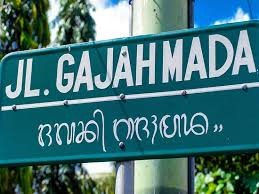
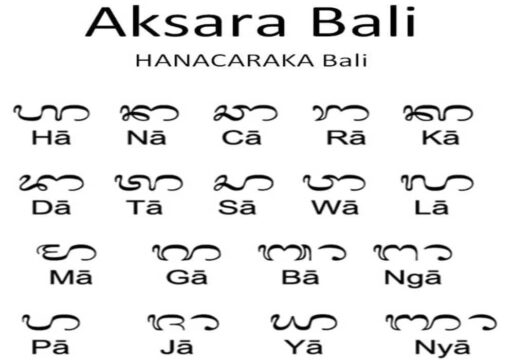
The Balinese script, also known as hanacaraka, is a pseudo-alphabet writing system (abugida) used for writing Basa Bali – a descendant of the Brahmi script – the ancient Sanskrit-based Austronesian Balinese language still used in the Island’s ceremonial and ritualized life associated with the Bali-Hindu religion. The earliest evidence of Balinese script is found on the still-extant Blanjong Pillar (Prasasti Blanjong), erected in the year 914 CE and still standing in the Village of Sanur, Bali.
Speaking in North Bali, Governor Koster said the requirement to use Aksara script has been in effect for nine years, since its first declaration in 2018. The Governor said using Balinese script is part of a strategy to exalt and conserve Balinese culture and is inseparable from the true origin and future development of a just Balinese civilization. Koster insists that the requirement to use Balinese script goes beyond a mere administrative obligation, but plays an essential role in preserving Bali’s ancient and esteemed culture.
Gubernatorial Decree Number 80 of 2018 requires Balinese script to be positioned ABOVE Latinized writing on a range of signage, including Balinese Hindu places of worship, traditional cultural agencies, building cornerstones, government offices, private institutions, road signs, tourism facilities, and other public places.
Balinese Aksara script should also be used on signboards for all places of religious worship. The format should present Aksara Script at the same size and proportion as any Latinized Script. Furthermore, when displayed on signage, Aksara Bali should have a red-and-white gradient background with black text.
For roadside locations that do not use standard signage, it is recommended to display both Balinese script and Latin letters—with the red Balinese script positioned above the white Latin letters—and also to incorporate decorative lighting.
Continuing, Governor Koster said the presence of Balinese Script represents a lasting testament to Balinese civilization. Koster alluded to several countries, such as China, India, Japan, Korea, and Russia, each with its own script that is consistently and widely used in public places.
Governor Koster proudly declared: “We should be grateful that our ancestors bequeathed to us the noble ‘Askara Bali’ Balinese Script, demonstrating that Bali is an island of a superior and advanced civilization.” According to Governor Koster, the Balinese script also represents Bali’s unique and beautiful identity, character, and essence, and possesses its own distinctive spiritual power.
The Governor praised compliance with the regulation and the growing use of Aksara Bali in public signage – now seen on many road signs, government offices, hotels, restaurants, malls, business places, and prominent community establishments.
At the same time, Governor Koster bemoaned that many office spaces, company signboards, shops, warung, and public facilities still have not included Aksara Script in their signage. These remaining non-compliant elements of the Aksara Script regulation demand serious action to bring all signage into legal conformity.
The Governor, who was officially presiding at a religious ceremony at the Sacred Puncak Luhur Sari Temple, then invoked the following: “With the blessing of Ida Bhatara, who resides at Pura Puncak Duwur Sari, I urge all parties—especially those who have not yet adopted the Balinese script—to conscientiously and with a high sense of responsibility comply with Bali Governor Regulation Number 80 of 2018.”
In closing, Governor Koster again reminded everyone that the absolute deadline for using Aksara Bali on all signage remains April 2027. Asking: “If we, as Balinese, do not take full responsibility for the preservation and future conservation of Balinese civilization and culture, who else then can be expected to take on their responsibility?”
It is not clear what sanctions or penalties will apply to government agencies or companies who fail to install Aksara Script signage before the April 2027 deadline.
The Governor closed his remarks, affirming strongly in Balinese language: “Ngiring Saeng -Sareng Pade Jengah Tur Satya, Nindihin Gumi Bali, Sane Luwih puniki!” (“Let us boldly and faithfully protect Bali, which is for the best!)
“Ngiring Saeng -Sareng Pade Jengah Tur Satya, Nindihin Gumi Bali, Sane Luwih puniki!” (“Let us boldly and faithfully protect Bali, which is for the best!)
Related Links
Governor Wants Balinese Script on All Signage
Bali Turtle Island Loves Basa Bali
BASAbali Wiki Recognized by US Consulate
A Month Dedicated to the Balinese Language
Stay Informed on Bali Tourism-Related News: Subscribe to Bali Update
“Ngiring Saeng -Sareng Pade Jengah Tur Satya, Nindihin Gumi Bali, Sane Luwih puniki!” (“Let us boldly and faithfully protect Bali, which is for the best!)
Bali Governor Wayan Koster