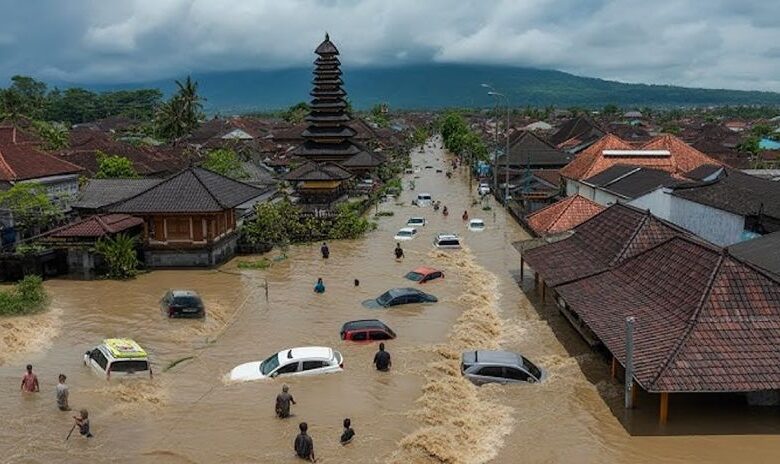
BeritaBali reports that global climate change is changing daily life on the Island of Bali. Altered and sometimes adverse weather is changing the Island’s landscape, bringing new ecological pressures, and causing economic disruption.
The Bali Zero Emissions Coalition – a cross-sectoral collaboration of organizations supporting the Indonesian government’s vision to achieve national net zero carbon emissions by 2045 – states that climate change impacts are not limited to Southern Bali but vary across different areas of the Island —from urban centers and highlands to coastal zones and agricultural regions. In urban areas and tourism hubs like Denpasar and Badung, there is a need to anticipate rising risks of urban flooding, flash floods, and coastal flooding (tidal inundation).
The Coalition is a collaboration of several organizations focused on environmental preservation and conservation, including:
- WRI Indonesia (Yayasan Sumber Daya Dunia)
- IESR (Institute for Essential Services Reform)
- New Energy Nexus Indonesia
- CAST Foundation (Culture, Art, Science and Technology Foundation)
- Azura Indonesia
Climate change impacts in Bali are driven by extreme rainfall and land-use changes that reduce the soil’s capacity to absorb water. Meanwhile, in highland areas and water catchment zones such as Bangli and Karangasem, shifting weather patterns have increased landslide vulnerability and destabilized upstream water sources.
Dry and coastal regions—such as Buleleng, North Karangasem, and the Klungkung coast—face a different set of threats. These areas face seasonal drought, coastal abrasion, and rising sea levels. Projections based on high-emission scenarios indicate that rising sea levels could trigger permanent coastal inundation, with flood depths exceeding two meters by 2045.
The agricultural sector and watershed areas in Tabanan, Gianyar, Jembrana, and Klungkung are also at risk. Changes in vegetation patterns could trigger watershed flooding and localized landslides, and disrupt agricultural irrigation systems. “Climate risks in Bali are becoming increasingly intense and persistent. And actually, it’s not limited to just Denpasar or South Bali; North, East, and West Bali each have their own unique challenges,” stated Aisyah Madeleine, Communications Specialist for the Bali Net Zero Emissions Coalition, during the Bali Climate Week 2026 outreach session and Focus Group Discussion (FGD) in Denpasar on Friday, 11 September 2026.
Bali’s Critical Fresh Water Deficit
Beyond hydrometeorological disasters, Bali also faces serious issues regarding groundwater reserves. Data indicates that Bali’s water demand has surpassed its total groundwater availability. Water demand is recorded at 4.06 billion cubic meters per year, while availability stands at only around 2.07 billion cubic meters annually. The agriculture, fisheries, and plantation sectors are the largest consumers, accounting for 90.81 percent of total water demand.
Pressure on water resources is a critical issue because Bali’s economic activity remains heavily reliant on natural resources. More than 50 percent of Bali’s Gross Regional Domestic Product (GRDP) depends on nature-based sectors—primarily tourism, agriculture, and fisheries. Land-use conversion across various regions is a threat that could reduce environmental carrying capacity while increasing risks to the community’s economic stability.
Bali Tourism Sector’s Demand for Water
The tourism sector alone contributes approximately 21 percent of Bali’s GRDP and is directly linked to about 50 percent of local small and medium-sized business enterprises. Climate change could create broader economic impacts.
Greenhouse Gas Emissions
Bali’s climate issues are also linked to high emissions from the energy sector and rising household waste volumes. The energy sector accounts for 93.02 percent of greenhouse gas (GHG) emissions in Bali. This contribution stems primarily from the electricity sector (46.4 percent) and the transportation sector (45.9 percent).
”In Bali, the energy sector is the largest contributor to emissions. Electricity usage—spanning both household consumption and transportation—accounts for 93 percent of that energy-related figure,” he stated.
Meanwhile, rising household waste generation is another issue that requires intervention at the source. Waste management is considered a crucial component in efforts to mitigate environmental impacts and reduce emissions.
To address these risks, the Bali Net Zero Emission Coalition is driving climate action through cross-sector collaboration in support of Bali’s Net Zero Emission target for 2045.
The strategy to achieve net zero emissions rests on four key pillars:
- Strengthening policies and low-carbon roadmaps
- Developing location-specific climate solutions
- Fostering cross-sector collaboration,
- Mobilizing funding, narratives, and education.
Regarding policy strengthening, the coalition supports translating climate commitments into regional regulations and development plans. This includes assistance with drafting the Regional Low-Carbon Development Plan (RPRKD), aligning the Provincial Medium-Term Development Plan (RPJMD), and creating sectoral emission-reduction roadmaps aligned with Bali Governor Regulation No. 45/2019 on Clean Energy Bali.
At the local level, various community-based approaches are being developed, such as low-emission zones through the Bali Low Emission Zone Initiative (BLEZI) in Sanur, renewable energy-based village programs in Baturinggit and Nusa Penida, and the Sustainable Fishermen Program in Kusamba Village, which utilizes renewable energy. Waste management efforts also encompass green start-up incubation and organic waste processing using the Black Soldier Fly (BSF) system in collaboration with TPS3R (Reduce-Reuse-Recycle Waste Treatment Sites).
On funding, the coalition is promoting increased financing for low-carbon infrastructure through the Bali Climate Finance Platform. It has also established a Climate Journalists Network to strengthen media capacity to report on climate change issues using data-driven, solution-oriented approaches.
Aisyah emphasized that addressing climate change requires more than technological solutions; it must also engage with how people live their lives.
”Action isn’t just about technology. Climate action should also address how people live, work, and socialize,” Aisyah concluded.
Related Website
Koalisi Bali Emisi Nol Bersih /Bali Net Zero Emission Coalition
Citizen Lawsuit in Bali Condemns President and Governor
Prabowo Calls for an Increased Disaster Mitigation Budget
Only 117 Hotels in Bali Certified for Disaster Preparedness
9 Dead After Floods Ravage South Bali
Bali Rice Fields No Longer Available for Villa Construction?
Bali to Ban Building More Hotels, Villas, & Restaurants
Governor Koster: No Moratorium on Hotels & Villas
Escalating Overtourism in Bali
Equitable Approach to Tourism Development
Poor Land Use Policies Blamed for Bali’s Floods
9 Dead After Floods Ravage South Bali
RI Tourism Minister Says Floods Will Not Cause Decline in Bali Visitors
Ubud Bali’s Main Street Closed by Bridge Collapse
Stay Informed on Bali Tourism-Related News: Subscribe to Bali Update