NusaBali reports that Bali Governor Wayan Koster has once again highlighted the inequitable disparity in economic activity between South Bali and the province’s six other regencies, while also noting tourism’s strong contribution to Bali’s overall economy. This situation is concerning because, despite Bali’s economy growing by 5.82 percent in 2025 and contributing 55 percent of national tourism foreign exchange earnings, the island’s economic structure remains heavily dependent on the tourism sector.
Koster made his remarks while hosting a working visit by the Budget Committee (Banggar) of the House of Representatives (DPR RI) at his official office – the Wiswa Sabha Utama Building, at Niti Mandala, Denpasar, on Friday, 02 October 2026. The visit aimed to gather input, suggestions, and recommendations on revenue policies and the allocation of transfer funds to regions within the State Budget (APBN).
Koster explained, speaking before the DPR-RI, that economic activity in Bali remains arguably over-concentrated in three areas: Denpasar, Badung, and Gianyar. Together, these three areas generate Locally-Generated Tax Revenue (PAD) of about Rp 10.9 trillion, while the other six regencies—Tabanan, Jembrana, Buleleng, Bangli, Karangasem, and Klungkung—generate only about Rp 2.3 trillion. “These three regencies generate Rp 10.9 trillion in PAD, while the other six generate Rp 2.3 trillion. So, the gap is very wide,” Koster summarized.
According to Koster, this disparity is inextricably linked to the concentration of tourism activities in South Bali. Consequently, developing new centers of economic growth is essential to prevent economic activity from continuing to cluster in that limited specific region.
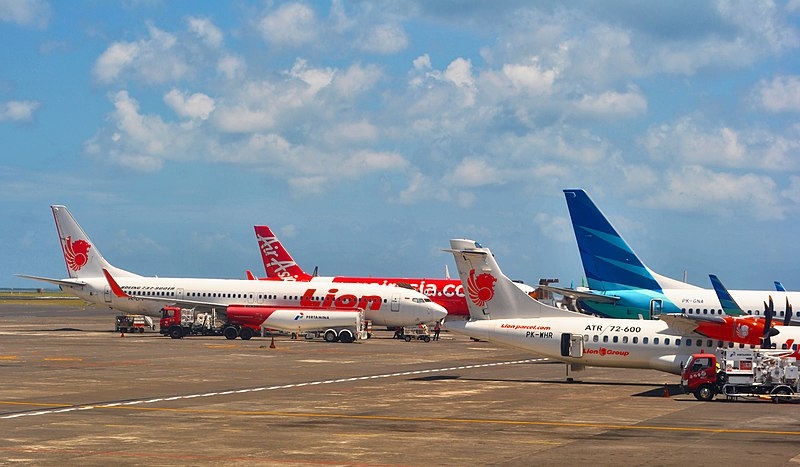
At the same time, tourism’s significant role positions Bali as a crucial player in the national economy. Throughout 2025, the number of foreign tourists arriving by air reached 7.05 million. Including domestic tourists, total visits reached 16.3 million.
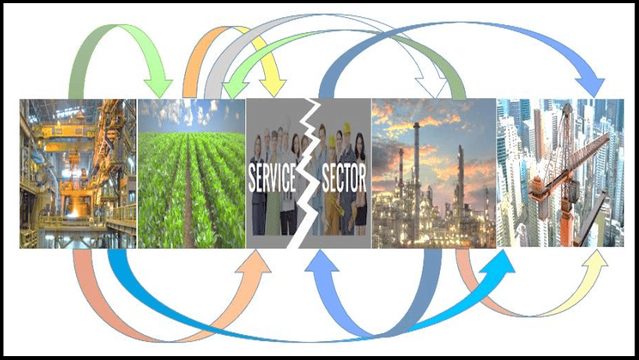
Bali’s undiversified tourism economy generated tourism revenue of approximately Rp 176 trillion, out of the national tourism total of around Rp 319.9 trillion. “This means Bali’s tourism revenue contributed 55 percent to the national tourism revenue,” explained Koster.
According to the Governor, this performance went hand in hand with Bali’s economic growth, which reached 5.82 percent in 2025—the fifth-highest growth rate in Indonesia. However, Koster emphasized that this growth figure must be viewed within the context of Bali’s economic structure, which remains heavily and arguably over-reliant on tourism.
He noted that approximately 66 percent of Bali’s local economy is linked to hotels, restaurants, and related sectors, including MSMEs. This dependency means fluctuations in tourist activity strongly influence Bali’s economic conditions. “Bali’s economy relies heavily on tourism dynamics; if tourism is thriving, Bali’s economy automatically thrives, whereas if tourism performs poorly—as it did during the COVID-19 pandemic—Bali’s economy suffers accordingly,” explained Koster, Chairman of the Bali Chapter of the PDI-P party.
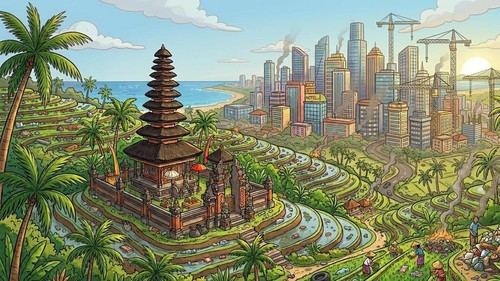
Koster stated that Bali needs to expand and diversify its sources of economic growth beyond tourism. Economic diversification is part of a transformation aimed at ensuring the community retains a livelihood when, from time to time, the tourism sector faces disruptions. “It was from the Covid-19 experience that we learned to undertake an economic transformation so that Bali would no longer rely entirely on the single tourism-based sector. Diversification of the Island’s economy ensures that if tourism is disrupted, the people of Bali will still survive,” said Governor Koster, who himself hails from Sembiran Village in the Tejakula District of Buleleng, North Bali.
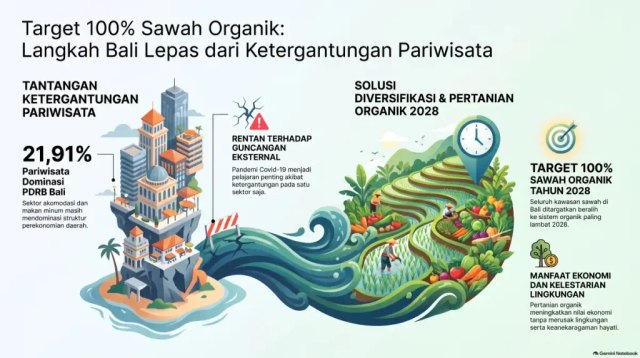
Koster emphasized that agriculture is one of the sectors being prepared as a new source of economic growth. He noted that about 70 percent of Bali’s 64,000 rice fields have already adopted organic farming systems. He said the government aims to have all rice fields in Bali use organic farming methods by 2028 at the latest.
According to Koster, organic farming is not merely about increasing the economic value of agricultural produce; it is also part of efforts to preserve the environment and safeguard biodiversity. The Bali government is also actively encouraging hotels to use organic agricultural products to strengthen the potential market for local farmers.
Beyond agriculture, Koster is focusing on food security and protecting local food production. One issue the Governor highlighted is the current deficit in garlic production and Bali’s current unnecessary heavy reliance on imported garlic.
Koster stated that developing local garlic production will require thousands of hectares of land. He called for support to expand Bali’s garlic production, thereby reducing the region’s dependence on supplies from outside areas.
Meanwhile, H. Syarief Abdullah Alkadrie, Deputy Chairman of the House of Representatives’ Budget Committee (Banggar DPR RI), noted that Bali’s economy grew by 5.78 percent year-on-year in the second quarter of 2026. This marked an increase from 5.58 percent in the previous quarter and surpassed the average national economic growth rate of 5.29 percent.
Despite this positive growth, the accommodation and food & beverage sectors continue to contribute 21.91 percent of Bali’s Gross Regional Domestic Product (GRDP). This situation demonstrates that tourism remains a primary driver for Bali while highlighting the importance of economic diversification to make the regional economy more resilient to volatility and global economic instability. The Budget Committee also emphasized the need to extend the benefits of economic growth to small and medium-sized enterprises (MSMEs), the agricultural sector, the creative economy, and local communities, ensuring that Bali’s economic growth does not rely solely on tourism.
Related Links
Bali New Fishing Port Expansion Targets Employment for 25,000 Workers
Pengambengan South Bali National Fishing Port Groundbreaking 29 September 2026
Government Stubbornly Proceeds in Building South Bali LNG Depot
Bali Targeted to Become Southeast Asia’s Largest Maritime Tourism Hub
Benoa Harbor, When Russian Superyachts Come to Call
Bali to Become a Yacht-Cruise Tourism Hub
Benoa Port – an International Port for Bali
Concert Venue to be Built at Port of Benoa
Bali Able to Host 5 Ships & 400 Yachts
Stay Informed on Bali Tourism-Related News: Subscribe to Bali Update